Easter Carmuirs – Ready for Action!

Next stop was just down the road to visit Rich Olyott and his P7 class at Easter Carmuirs Primary School.

Rich and his class are yet more blogging friends, and we had lots to catch up on when we made it into the classroom.

A solid bank of interesting and thoughtful questions were fired at us – and this time it was MrsP who was having trouble with accents ;-I.

I think we all came to realize that both countries and kids have a lot in common, although it was the differences in scary creatures and climate that caused the most “oohing and ahhing” from the kids.

Spiders, sharks, snakes, stingrays and other assorted deadly creatures were very popular topics and promises of some scary creatures to be sent over from Australia were made.

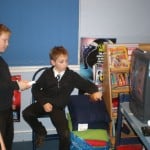
After a tour of the school by some very capable and talkative tour guides, we returned to the P7 room to be shown the many ways the class uses games in their learning.

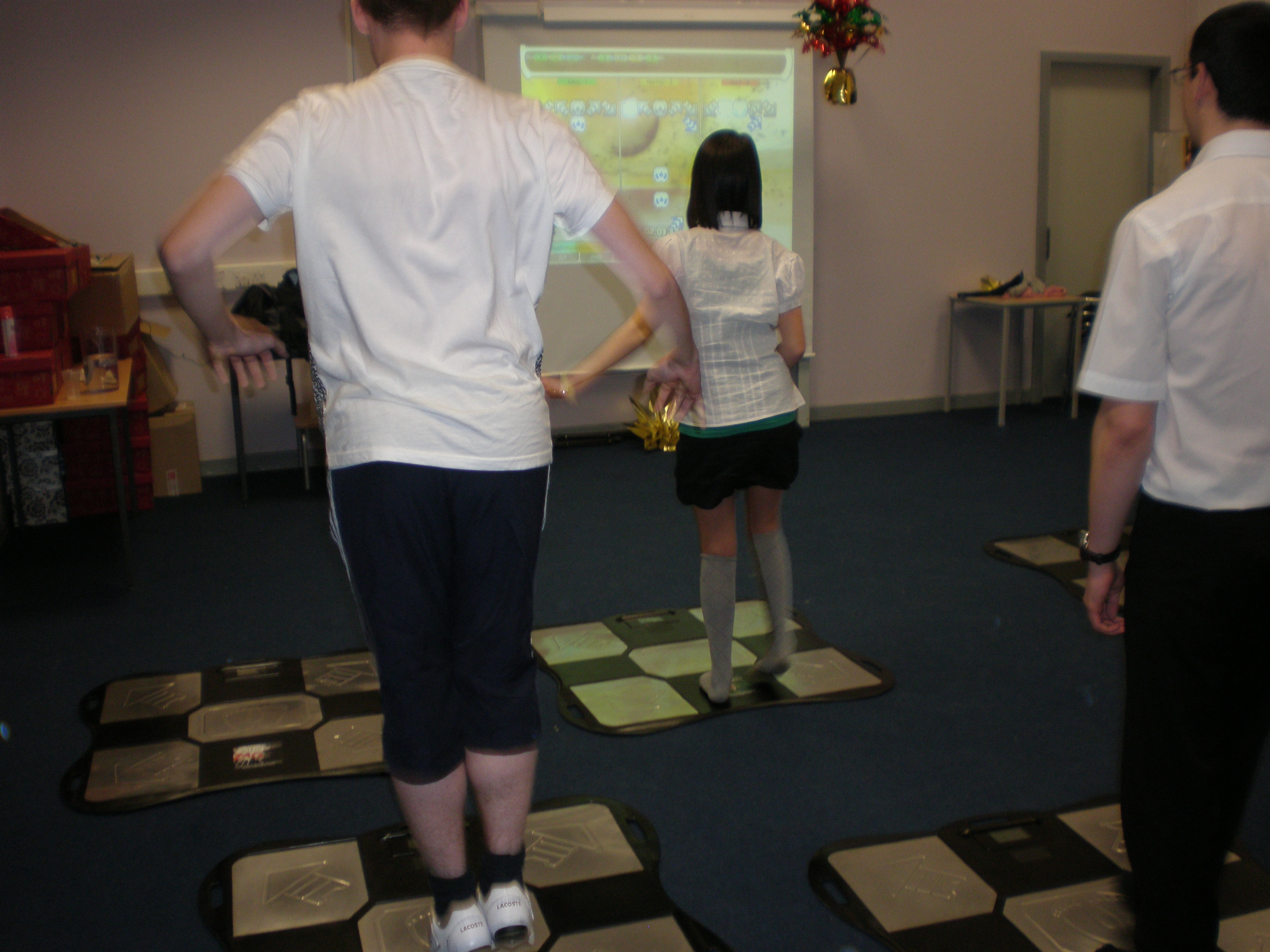
We saw dance mats being used for gross-motor skill development,


Buzz questions for general knowledge, and wii sports for addition and subtraction games. Everyone was positive and enthusiastic about how games were being used and could articulate the why and how games helped/supported learning.

Whew! I love being part of a busy, enthusiastic and engaged classroom! A big thank you to Rich, P7 and Margaret for a fun filled visit!

 Here is a slide show Mrs Vass made……. thank you :_)


East Lothian Inspiration

A HUGE thank you to Ollie Bray who organized a busy and information packed Wednesday that took us to Wallyford Primary and Musselburgh Grammar to see Games -Based Learning in action in a variety of classes and age groups.

Gail and I were accompanied by Margaret and led out by Ollie to see a range of game platforms being used by great teachers, enthusiastic students and a proud & passionate Mr Bray.

Without exception, students from the two schools were engaged and enthusiastic about the use of games in their classrooms. Whether the games were being used for skills practice, skill speed improvement, concept development, or as a context for learning new skills  – students responded to the playfulness and fun of the games.

This allowed teachers to harness and support this enthusiasm into meaningful learning experiences for their students.  Maths drill and practise became purposeful and competitive; story writing was embedded in a shared context; and dance and movement was personally challenging with goals and targets to keep on track.

It was interesting to see how the teachers “unpacked” the learning taking place with their students. Discussions, suggestions, strategies and rules could be seen in charts and on walls of the classrooms that indicated the learning that was taking place was deeper than the skills emphasized in the games themselves.


Problem solving strategies were listed and articulated, child protection issues were talked about and solutions offered, management routines were developed with and by the students. All of which engendered ownership of the learning that was taking place, and the strategies and routines that students could use to confidently use and make the most of the games and learning they were involved with.

All in all a wonderfully fun and enlightening day in many ways. Thanks to the teachers who were so willing to share their classes and teaching with us.


Permission to Adventure

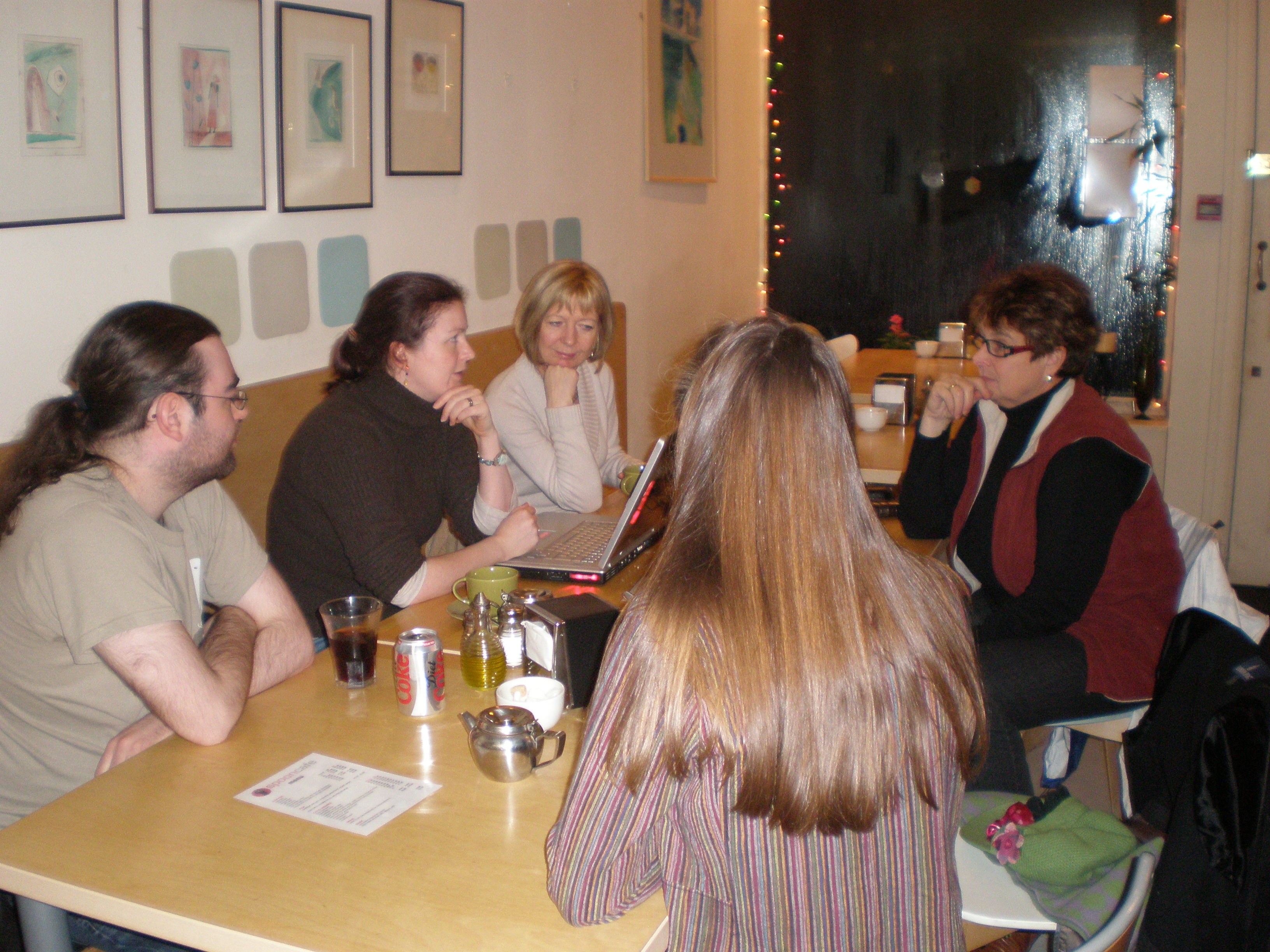
Snug and warm in a tiny café off the Royal Mile, we met up with the Adventure Author team: Judy, Cathrin and Keiron, to catch up and to discover what everyone had been up to since we last met.

The Adventure Author Project has finished, and the intrepid three are moving on so it was a good time to recap and talk about what they had found out and where they might go next.

Judy shared some of the newer features of the Adventure Author software:

1.    Comment Cards – which allow comments to be made and shared between students and the teacher

2.    Evaluation Page – specific criteria to be evaluated

–       star rating

–       attach evidence option

3.    To Do List – to keep track of what has been done and what needs to be done next

And we discussed how they have been used by students how they might be used by teachers to scaffold and support writing (as well as game making).

Judy and her team insist that students are at the centre of their learning – that students need to drive their own learning, work together to explore and discover and then share what they have found out.

This approach seems to give students the permission to take responsibility for their actions/plans, gives them the structures to develop their learning around and the confidence, time and expectation that they will then share and evaluate what they have done or discovered.

We discussed how this approach works in various settings (with undergraduates and Primary students) and all felt that an unexpected bonus was the creative way students could (and did) respond to the challenge of being in control of the what and how of their learning.

As always, some wonderful and thought provoking ideas about creativity ensued – eg does one create and then find a purpose for the creation or does one create for a purpose or does one create because they can?????? (Maybe all at different times).

Thanks team for a great afternoon and night of interesting, provoking and thoughtful discussions and sharing. Looking forward to hooking up with something new in the not-too-distant-future.


Why & How: Computer Games & Writing?

I have been using games in my classroom for nearly two years now and have been constantly surprised at the excitement, success and achievements of my students in this time. My students’ writing has especially been of interest to me and I have thought long and hard about how and why using games elicits such wonderful responses.

I first used PS2 game back stories as models (in 2006) for my students to write their own stories with surprising results. I then moved on to the very different and beautiful Samorost and Samorost 2 games as stimulus (2007) with again, wonderful results.

Using historical stories to build their own games, and write the back stories (also 2007) encouraged the students to come up with interesting and well thought out ideas.

Most recently I used Mario and Sonic at the Olympics as stimulus for writing poetry, which also yielded positive results.

Lots of different games, from internet based to COTS, yet all had great impact on the quality of the writing produced by my students. Why? How?

Well, in a coming together of ideas and professional learning over this time, I’ve read “Out of Our Minds. Learning to be Creative” by Sir Ken Robinson. So much of what he said made sense to me and led me to this post of thoughts as to why using games with my Primary aged students helps their writing.

The use of the games allows for and promotes creativity!

Robinson refers to creativity as

  • doing something
  • an action
  • applied imagination
  • valuable
  • public
  • original
  • a process rather than an event

most of these aspects can be linked to the use of computer games within my class. Perhaps my students are creatively learning – is that it?

I would love to know what you think 🙂

Collaborative nature of using games with the whole class on the big screen enables all to participate at whatever level they are comfortable with: amateurs, newbies, competents all have some stake in the game; all have important comments and views to share.

Newbies are seeing things for the first time – they can often share new perspectives that competents and amateurs hadn’t thought about.

Newbies ask questions that competents and amateurs can try to answer – by articulating what they know and teaching others the whys and hows of the game, strategies, language and information within the game can be shared.

Sharing of knowledge, ideas, vocabulary and the “piggy backing” of thoughts helps to grow new ideas and thoughts. Robinson says that we make sense of the world by trying on ideas for size. Shared vocab, shared imagery – this belongs to all of us. Sharing of the language involved provides models and scaffolds that support all learners – ESL, language disordered, struggling and advanced users of English. 

Sometimes the class starts with a common sentence, and everyone builds that sentence into something new. New vocab has meaning; new ways of saying something are shared and modelled. The language belongs to all of us, it gets better and more descriptive the more we use it and mould it to what we want to say.

Striving for more – students push themselves to get better/ be better. They work and think hard together, as a class, to achieve, to make the work stronger, the images clearer and the language richer. Students enjoy the notice, the acknowledgement of their classmates when they come up with a great idea, word, image or phrase.

During the game and the learning sessions, students are working for the common exploration of the game, the theme, the topic; they are working together to explore and imagine. There are no grades, no external reinforcement, just a sense of accomplishment and pride in what they can do. Pushing past what they thought was their best, to speaking, writing or thinking something that is new, improved and satisfying.

A community. My students are not isolated it’s not them and a blank page – everyone starts together through talking and suggesting. The game provides a shared beginning with lots of “jumping off” points to get them started and on their way.

The oral aspect is vitally important for all students. Trying out ideas, and how they sound in English, and how they might best be written is hard for my ESL students- many of whom don’t yet have a strong idea of exactly how English should sound.

Acceptance of their ideas, providing alternative ways of saying the same thing, playing around with the language in a supportive way builds up the sense of community – everyone has something to offer.

Drama is a fantastic way to tease out new ideas and concepts especially when students are struggling with finding the English words for what they are seeing. Even advanced English speakers are able to develop their vocabulary through dramatic representation of what they are seeing and doing on the screen, in the game.

Students are motivated to try new ideas, new imagery, new ways of approaching writing in a supportive, yet exciting environment. My students are in a familiar domain (computer games) and can relax into the rigorous school domain where they are expected to write (in English) about unfamiliar topics, events and experiences. Their motivation seems to run deeper than simply playing computer games in school. They are being asked to do more than just play the game – they are being asked to think, to respond, to create, to move past the actual game in front of them, to record and deliver their ideas in new and interesting language.

Safe risks where students are encouraged to take risks and realize that to fail (some ideas they have will be better than others) is an important part of learning. Sometimes the flow of ideas and talking is so fast that it’s hard to get what you want down, but in this environment my students can see that their writing is not permanent – they can change it, add to it, re-arrange it, and if they really don’t like it cross it out or leave it and move on. Robinson beleives that creativity involves a dynamic interplay between generating ideas and making judgements about them. We get more ideas, and better ideas through taking these safe risks in a supportive atmosphere.

How different this is from the prolonged agony of no ideas, an empty white page and 20 minutes to write something, anything, at all. When all there was time for was to write down the first thing that came into your head, and it stayed there on the page mocking you (but it really didn’t matter because you didn’t need to read it again anyway. The teacher was the only one who read your work!).

The excitement and noise of ideas bursting forth, of being re-written and re-worked, of being tried out and accepted or laughed at and rejected, only to be picked up again later and turned into something useful. Or the quiet of pencils scratching workbooks, students mumbling sentences under their breath and a sigh of success as their writing works out and they finish off with a flourish and a grin J


I don’t know ………, I’m scratching for answers or insights into why gaming offers such impetus to my students. Is it the creative aspects of the tasks that appeal and resonate with the students? I do know that using computer games has impacted strongly and positively on my classroom over the last two years. Hopefully I’ll find out more (answers or questions – I’m not sure) when in Scotland and England early next year!

Image: ‘The Questions Crap
www.flickr.com/photos/84959877@N00/152579107
 

Dolphin Island Delight

I was feeling very guilty … I was letting my Year 4’s down … I had planned a series of activities to “do” with the Year 4’s (ages 8-9) that tied in with the Dolphin Island game, but I hadn’t had time to do more than explain some of the ideas of what we could do.

 When I finally called them all together to get “started” I had no takers – they were all otherwise engaged!

 Four students were bunkered down on the pillows totally absorbed in playing the game. Someone called “TIME” and the games were passed on to the next player, the groupings moved around and the next lot of kids were soon quickly drawn into the game as well.

 A little group were huddled around the DOCs (Dear Old Computers or Dead, Old Computers depending on the current state of operability!) reading and typing from their writing notebooks information about dolphins onto the class wiki.

 One little person was flicking through non-fiction texts looking for creatures that were in the game. Winson was looking up more facts about orcas on the internet – and pushing his and my current knowledge about the relationship between dolphins and orcas.

 I didn’t want to interrupt so left them till later.

 However…… later on ….

  •  some Year 4’s were looking for images of sea creatures from the game on Flikr to use in an art design project,
  • others were involved in the design work,
  • another pair were playing the game,
  • Deon was writing out his narrative that would accompany the Voki he was going to make about orcas,
  • Justin was searching through Flikr creative commons to find new pictures that he could legally use to illustrate the information reports he had written for the wiki about a number of marine animals.

 I’m afraid that my Year 4’s are just too busy

  • Organising
  • Directing
  • Negotiating
  • Sharing
  • Supporting
  • Investigating
  • Hypothesising
  • Researching
  • Contributing
  • Planning
  • Writing
  • Reading
  • Experimenting, and
  • LEARNING

to “do” my activities.

 Isn’t it great 🙂


DSLites & Dolphin Island

My class is studying oceans and conservation at the moment and all are involved in projects on an area of interest related to this overall topic.

I had been waiting for an opportunity to try using the school DSLites with my class. I had come across the game “Dolphin Island” and knew that the time had arrived 🙂

The 9 Year 3 & 4 students are the target group as they still need/enjoy a little more structure than the rest of the group. As well as playing the game and learning about conservation, there are a number of other off computer activities that this group will be undertaking as well.

The students are researching a sea creature and adding the info to our class wiki, identifying conservation issues and trying to work out solutions, measuring sea creatures, investigating mathematical problems based on the game, and participating in art/craft activites!

What fun! 

Haluz and Narrative Writing Part 1

 In May, Australia is undertaking, for the first time, national (as opposed to states-based) literacy and numeracy testing for students in Years 3, 5, 7 & 9. In the follow-up information received after last year’s state based testing (the NSW Basic Skills Test) my school identified a variety of areas we needed to focus on this year to improve our school results.

In the Literacy – Writing area our Areas for Focus were identified as:

  • Text Processes: Effective orientation
  • Text Processes: Effective resolution
  • Topical language
  • Figurative language
  • Paragraphs
  • Sentence structure
  • Punctuation

The genre of Narrative is the only text type required this year, so my time has been spent working on my students’ narrative writing.

Last year I explored the use of the on-line “point and click” game Samorost with my class, and used it to work with my students on their writing skills. The results were inspiring and very exciting – you can read about what we got up to here ….

I was keen to use a computer game again to explore writing, and to motivate, engage and involve my students in writing narratives. However, I didn’t want to/ couldn’t just repeat what I’d done last year (two thirds of my class this year were in my class last year) as I was interested in a number of areas:

  • to explore what other areas of writing lend themselves to using a game
  • to investigate if more structured, text-based writing skills could be learnt/taught/practised using a game

Fortunately I came across another post from Ewan , who threw out a link to Haluz – a “point and click” game in the same genre as Samorost – which has meant that I can explore some more with my students  ……  and teach writing as well   🙂 

You gotta love that don’t you?

dsc04609.JPG    dsc04610.JPG

ReView and PreView

 timeout.jpgAfter an interesting week or so on Jury Duty I’m back – rearing to go after an enforced “time-out”. 

My last week at school saw me using our new laptops in my room. After a frazzled first session – sorting internet cords, and placement of the laptops within the room – we made a great start at our individual maths focus contracts. The students felt responsible for getting on with their work and seemed very motivated to work on their own to complete the maths topics they needed to work on. 

The setting up of the laptops got quicker over the week and the students came up with exciting ways to take advantage of the laptops when they were set up. We had a great session with the kids working in threes using Google Earth to locate places referred to in the “Behind the News” current affairs program we watch each week. 

My use of the iWB was probably not as exciting as I had hoped – a few techno problems, but they will be sorted soon I hope and I will continue on (and on and on!) 

My focus for this coming week will be:

  • Laptops – in the room as much as possible – set up and ready for the kids to work on.
  • Writing Focus – narrative using an internet game again to support and motivate students and improve their writing. This time I will start with the planning of the game narrative: does it fit the planning model we are using? How does it differ? How are the different parts of the narrative linked to each other?

            Hmmm, lots to work on here!

  • Look at using the DSLites for daily? thrice weekly? basic maths practise. I’m sure this will really motivate the class to improve their basic operations skills, and by recording their scores we can collate and graph results. This will link in to the Data section of our Mathematics curriculum, and “interpreting graphs” is an area my students need to work on.

        The DSLites are set up to use in the Library at lunchtimes so I will have to make sure we use them first thing in the morning and then reset them up ready for lunch 🙂

 Heaps to look forward to……. BIO!  (bring it on!  😀  )

Image is “Timeout” by katenet

Gunning for MissionMaker!

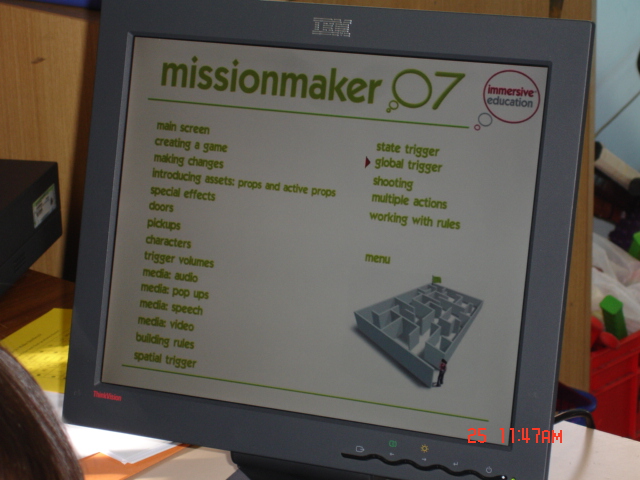
Spent the beginning part of Term 4 trying to complete our MisssionMaker games to put on our blogs. The kids took many hours tweaking their games, adding special effects and tricks, which in the end probably got in the way of the games they were making. 

I was really impressed with the way that they took on the challenge of making the games. They were not given much input into how to get things to happen in their games. Word of mouth and “experts” helped them along, trial and error and lateral thinking also enabled everyone to come up with a basic game. 

Of interest was the depth of focus of the students. All were totally focused on bringing their historical knowledge to the fore. They knew exactly what they wanted to do and there was very little use of guns within the games. I hadn’t given any instructions re guns and violence; I thought I would just see what evolved as they were making their games.  

I had discussed this issue with John Westwood from Lower Wyche C of E School in England, and he had noticed that his students had a bit of a play with the shooting aspects, but then moved on and concentrated on other areas of the game making. I found that this happened in my classroom as well.  Most of the class played with shooting things, but quickly moved onto making their historical game – we had explosions and fires but no death and destruction as such. 

The big exception to this happened when I received some “extras” into my class at the beginning of Term 4. These students hadn’t done any research into an historical period, and the MissionMaker game making was a bonus activity, rather than a purposeful way to demonstrate their learning of a topic. In these student’s games shooting was the be all and end all of the game. There was no other purpose to their games but to hunt and kill opponents. Interesting, but hardly surprising! 

Unfortunately the license for MissionMaker ran out at the end of the school year – not sure if this will affect our ability to post our games onto our blog for everyone to play or not.

dsc03204.JPG