Oh, I See!

im-blogging-this.jpg 

 Dean Shareski recently posted about blogs that succeed, and listed five simple ways he’s discovered to help students and teachers blog successfully:

Blogging is mostly about reading

  • Provide as much time to read blogs as write
  • When writing make sure you are responding to something you’ve read, seen or heard

To make a friend you have to be a friend

  • If you want people to read and respond to your work, you will need to read and respond to theirs
  • We have 2 ears and 1 mouth!

It’s personal

  • Write about what you know
  • Don’t lose the concept of conversation – it must flow from personal meaning
  • Write stories that others can relate to and contribute to

Hyperlink

  • Validity of blogs without links?

Get graphical

  • Words are only one way to express ideas
  • Embed video, audio and images
  • Communicate beyond just words

I’ve been struggling a bit lately with finding the impetus to write, and I think its because I’ve over planned the whole “story” too much.

I’ve also been doing lots and lots of reading but not responding in any way – just thinking “Yeah, I agree with that!” and moving on to the next post.

Maybe I need to explore graphical ways of communicating – try out some new applications so I can use them/show them in class as well.

I shared Dean’s suggestions with my class and they had a lively discussion about the ideas raised – we’ve all agreed to get down and serious about improving our blogging this term, just you wait and see if we don’t   🙂

Haluz – playing with words!

  I noticed many times during our work with Haluz that the kids were re-working paragraphs or sentences to get better effects. They would start off with an OK paragraph, sentence or idea, and then have another try, often changing the word order around.Sometimes they would try out various emotions and the associated vocab or language that went with the emotion. Over the years I’ve been constantly frustrated by my students inability or unwillingness to work on their writing – to improve the meaning, even to edit their work. Yet I have noticed that many students seem to enjoy working at making their sentence or paragraphs interesting, clear and entertaining.

This playing about with words and language – either to experiment with the power of the words, or to try out different effects of words – is really positive and encouraging. 80%of my class speak another language at home, and have rarely had the time or the confidence at school to experiment and play with English.

In our hurry and intent to “teach” non-English speaking students as much English as possible, we haven’t allowed time to use language for “play” purposes. I noticed my students were excited to try out different ways of writing the orientation, or about a character, or about an event they had experienced in the game. Was it the control over their writing? over their ideas? over the language? that was most exciting? Or was it the confidence of being in charge of English and being in charge of their story? What do you think?

Haluz – Creating A Colourful Character!

  In this session we looked at the various characters in the game.We discussed (as we moved through the game, often retracing our steps, or jumping ahead to see/watch/view the particular character we were talking about)

  • the lack of main or “big” characters in Haluz
  • what each character added to the game
  • the personality characteristics that each character had/showed
  • how we knew what the character was like – and what made us think that way
    • background music
    • way the character moved
    • what the character did
  • what the character might have been feeling/ hearing/thinking at different points in the game
    • and how this influenced the characters movements
    • how the words we used to describe  changed according to how the character was feeling/acting

During this session we couldn’t help but act out different ways of moving, of reacting, and of thinking whilst we were “in character”.

The kids then had some time to work on writing about one of the characters. I think they made some great attempts at actually “being” the character …… what do you think?

“Sendrick the snake had never heard music before, so he hastily pulled himself out of his basket when the strange music began playing”  Sarah.

“Zaffa the hungry snake ferociously swallowed the cute furry mouse like a racing car going at great speed” Moustapha.

“Watching the mouse as carefully as a shark spying on it’s prey, Valisa, the suspicious snake waited for the mouse to peek out of the tiny hole” Momtahina.

“George excitedly popped out from his basket when he heard the beautiful music”  Steven.

“I stomped outside to see what was going on. Even though a vulture-like predator had my satellite dish I couldn’t help but smile. I was about to embark on a miraculous quest …” Timothy.

“Peeping out of the ancient box, one eye after the other, I rise carefully with caution, to the roof of the slimy lizard’s mouth. Jerking upwards towards the lizard’s dirty, disgusting tongue, I shake my head sideways and bump into the lizard’s throat, giving him a constantly sore throat” Naomi.

“Carelessly, I sprang out of the straw basket swaying to the music, not thinking of what I was doing. Only one thought was on my mind, “sway to the music” for I had not heard the marvellous music that I was swaying to right now for what felt like a hundred years”  Natalie

haluz-bird-rocket.jpg       bird-on-roof.jpg   

Haluz and Narrative Writing Part 1

 In May, Australia is undertaking, for the first time, national (as opposed to states-based) literacy and numeracy testing for students in Years 3, 5, 7 & 9. In the follow-up information received after last year’s state based testing (the NSW Basic Skills Test) my school identified a variety of areas we needed to focus on this year to improve our school results.

In the Literacy – Writing area our Areas for Focus were identified as:

  • Text Processes: Effective orientation
  • Text Processes: Effective resolution
  • Topical language
  • Figurative language
  • Paragraphs
  • Sentence structure
  • Punctuation

The genre of Narrative is the only text type required this year, so my time has been spent working on my students’ narrative writing.

Last year I explored the use of the on-line “point and click” game Samorost with my class, and used it to work with my students on their writing skills. The results were inspiring and very exciting – you can read about what we got up to here ….

I was keen to use a computer game again to explore writing, and to motivate, engage and involve my students in writing narratives. However, I didn’t want to/ couldn’t just repeat what I’d done last year (two thirds of my class this year were in my class last year) as I was interested in a number of areas:

  • to explore what other areas of writing lend themselves to using a game
  • to investigate if more structured, text-based writing skills could be learnt/taught/practised using a game

Fortunately I came across another post from Ewan , who threw out a link to Haluz – a “point and click” game in the same genre as Samorost – which has meant that I can explore some more with my students  ……  and teach writing as well   🙂 

You gotta love that don’t you?

dsc04609.JPG    dsc04610.JPG

Mind Map Magic

I am so excited about being able to embed things like this into my class blog, that I had to blog about it here too 🙂


How cool is this?

Last week we tried out a mind mapping tool called mind42.com to organise our thinking about Natural Disasters.

We had just been introduced to Natural Disasters through some wonderful hands on science activities from the CSIRO and we thought that we would like to investigate further.

This is what we came up with – have a look at the map above – you can move themap, make the text bigger/smaller, open and close the nodes. WOW

AllStars – leave a comment about the area you would like to investigate.  

ReView and PreView

 timeout.jpgAfter an interesting week or so on Jury Duty I’m back – rearing to go after an enforced “time-out”. 

My last week at school saw me using our new laptops in my room. After a frazzled first session – sorting internet cords, and placement of the laptops within the room – we made a great start at our individual maths focus contracts. The students felt responsible for getting on with their work and seemed very motivated to work on their own to complete the maths topics they needed to work on. 

The setting up of the laptops got quicker over the week and the students came up with exciting ways to take advantage of the laptops when they were set up. We had a great session with the kids working in threes using Google Earth to locate places referred to in the “Behind the News” current affairs program we watch each week. 

My use of the iWB was probably not as exciting as I had hoped – a few techno problems, but they will be sorted soon I hope and I will continue on (and on and on!) 

My focus for this coming week will be:

  • Laptops – in the room as much as possible – set up and ready for the kids to work on.
  • Writing Focus – narrative using an internet game again to support and motivate students and improve their writing. This time I will start with the planning of the game narrative: does it fit the planning model we are using? How does it differ? How are the different parts of the narrative linked to each other?

            Hmmm, lots to work on here!

  • Look at using the DSLites for daily? thrice weekly? basic maths practise. I’m sure this will really motivate the class to improve their basic operations skills, and by recording their scores we can collate and graph results. This will link in to the Data section of our Mathematics curriculum, and “interpreting graphs” is an area my students need to work on.

        The DSLites are set up to use in the Library at lunchtimes so I will have to make sure we use them first thing in the morning and then reset them up ready for lunch 🙂

 Heaps to look forward to……. BIO!  (bring it on!  😀  )

Image is “Timeout” by katenet

My Week in Preview

focus.jpg

Thanks to a motivating post from Jess McCulloch (language teacher from Victoria, Australia), I am trying out a preview post to focus on the week ahead.  

Jess said, “I get to think about what I really want to get out of this coming week which allows me to focus my planning a bit more. I’ll be able to check back at the end of the week and see how I’ve gone and then start all over again for the following week. Hmm, could be a good process!”

I agree! I always seem to have a plethora of things that I have to accomplish, it all gets overwhelming, so I give up and accomplish very little at all. I’m hoping that by focussing and writing down a few items to concentrate on, I will be able to keep what is important at the forefront of what I am doing, and I will be able to actively work at achieving/doing what I set out to do.

1. Laptops: I am going to take advantage of our mobile school laptops in my room. My students can use them for their individual “Areas of Focus” work in Maths. This will allow everyone to work through the protocols of using the laptops, as well as having the opportunity for some on-line Maths work.

2. iWB: I will use my board in three new ways this week (Thanks again Jess  🙂   )

3. Blogging: tutoring of class “newbies” by class “oldies”  worked really well last week, so I will continue this week by focussing the class on

  • positive commenting – keeping conversations going
  • “inside” a blog – how to find your way around, what it all the headings mean, how to post

So, I know exactly where I want to go this week (and I’ve written a blog post too 😛   ) and as Jess said, “Bring It ON!”

Image is “Focus” by ihtatho

Gunning for MissionMaker!

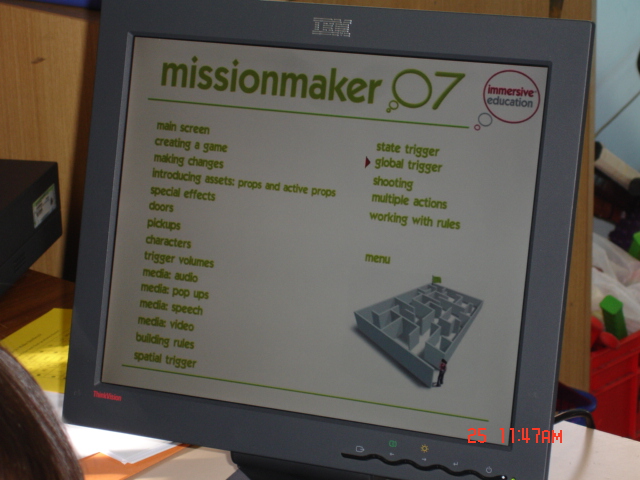
Spent the beginning part of Term 4 trying to complete our MisssionMaker games to put on our blogs. The kids took many hours tweaking their games, adding special effects and tricks, which in the end probably got in the way of the games they were making. 

I was really impressed with the way that they took on the challenge of making the games. They were not given much input into how to get things to happen in their games. Word of mouth and “experts” helped them along, trial and error and lateral thinking also enabled everyone to come up with a basic game. 

Of interest was the depth of focus of the students. All were totally focused on bringing their historical knowledge to the fore. They knew exactly what they wanted to do and there was very little use of guns within the games. I hadn’t given any instructions re guns and violence; I thought I would just see what evolved as they were making their games.  

I had discussed this issue with John Westwood from Lower Wyche C of E School in England, and he had noticed that his students had a bit of a play with the shooting aspects, but then moved on and concentrated on other areas of the game making. I found that this happened in my classroom as well.  Most of the class played with shooting things, but quickly moved onto making their historical game – we had explosions and fires but no death and destruction as such. 

The big exception to this happened when I received some “extras” into my class at the beginning of Term 4. These students hadn’t done any research into an historical period, and the MissionMaker game making was a bonus activity, rather than a purposeful way to demonstrate their learning of a topic. In these student’s games shooting was the be all and end all of the game. There was no other purpose to their games but to hunt and kill opponents. Interesting, but hardly surprising! 

Unfortunately the license for MissionMaker ran out at the end of the school year – not sure if this will affect our ability to post our games onto our blog for everyone to play or not.

dsc03204.JPG

wii Boogie on Down!

 our-new-wii.JPG

We got down and boogied this term!

We used the wii Boogie game to try and get some dance moves happenin’ ready for the Year 6 Farewell Dance at the end of the year. 

I had hoped to integrate a number of areas of the curriculum with this game program, as I thought it would be a fun and motivating way to end the year. And it was fun and motivating but it didn’t pan out exactly the way I had in mind, and I wasn’t able to implement everything I hoped to.  

Rather than imposing all my ideas about the game and how it could fit into our learning, I asked the class for their thoughts and ideas first. They came up with some ideas for science investigations into the heart, lungs and blood, as well as identifying “sound” as another possible area of study. 

We thought that we could set up some sound experiments around the room (modeled on the way the CSIRO set up their school science programs that we took part in earlier in the year). Students would arrange themselves in pairs or groups of three and prepare an experiment for the rest of the class to do.  

The other science ideas involved research  of the heart, blood or lungs and writing up information into their scrap books (interesting that the students volunteered to hand write their work, and that they were concerned because they hadn’t done much work in their scrap books over the year – this is another post in itself I think 😉  ) 

It was at this time though that the network went down, we couldn’t use the computers for much besides word processing – and even then we couldn’t save our work. Time took care of the computer problems, but meant that we didn’t have enough left to get our investigative science work done. 

We also invented some new characters to introduce to the game, students wrote introductory back stories for their character, based on the back stories of the characters already in the game. They also painted a representation of their character, but the best part was using Vokis to make their characters come to life on our blog! The students designed their characters using the available heads, facial features and accessories on the Voki website, they read their character story and added it to their created avatar and VOILA a talking character made by the students for everyone to see and hear. Great fun! Check out some more of our Vokis on our class blog here and here.

celias-voki.jpg         nancys-voki.jpg        emilys-voki.jpg         arenas-voki.jpg         mikhailas-voki.jpg         kesaiais-voki.jpg        

[kml_flashembed movie="http://vhss-a.oddcast.com/vhss_editors/voki_player.swf?doc=http%3A%2F%2Fvhss-d.oddcast.com%2Fphp%2Fvhss_editors%2Fgetvoki%2Fchsm%3Dfc7a3c22592953ce98fc4c7112c4fd54%26sc%3D109414" width="200" height="267" wmode="transparent" /][kml_flashembed movie="http://vhss-a.oddcast.com/vhss_editors/voki_player.swf?doc=http%3A%2F%2Fvhss-d.oddcast.com%2Fphp%2Fvhss_editors%2Fgetvoki%2Fchsm%3D8c3390894a316a18debdbbb1d3c50d11%26sc%3D113809" width="200" height="267" wmode="transparent" /]

There was a problem with the Boogie program however, that stifled some of the fun and the ability of the students to interact to a great degree with the game. When we plugged the wii console into the data projector the sound level on the wii was really low, there was no speaker outlet on the data projector. It made it virtually impossible to hear the music on the game, which meant the game was hard to play.

We tried to work around this by using the wii when groups of the class were out of the room, or whilst everyone else was doing quieter work at their desks.  It is not possible to have the wii connected all the time either, as we use our interactive whiteboard for other areas of study during the day as well. This was another work around type problem that we had to overcome – not huge, but just one more thing to get in the way of using the program in the way we had envisioned. 

All in all, even though we ran out of time to complete this project, the parts that were finished were great! We will have to see if we can’t continue on with our science investigations later on this year.

Connected Students @ Connected Learning

[kml_flashembed movie="http://widgets.clearspring.com/o/46928cc51133af17/4706062610609a4e" width="432" height="250" wmode="transparent" /]

On Wednesday a group of students from our school (Belmore South PS) – including 3 AllStars – represented us at the “Connected Learning Conference” at the Novotel Hotel at Brighton.

The students formed a panel to discuss their experiences using GameMaker to make digital games.

Students demonstrated their completed games, walked through how to make a game, and held a panel discussion about the value of making games in class, the educational benefits, what they learned, and their thoughts on game making. The students even answered questions from the audience.

The response from the teachers and educators in the audience was positive- and the students were professional, passionate, articulate and impressive.

Congratulations to everyone involved – you are a credit to youselves, your families and your school – thank you.